

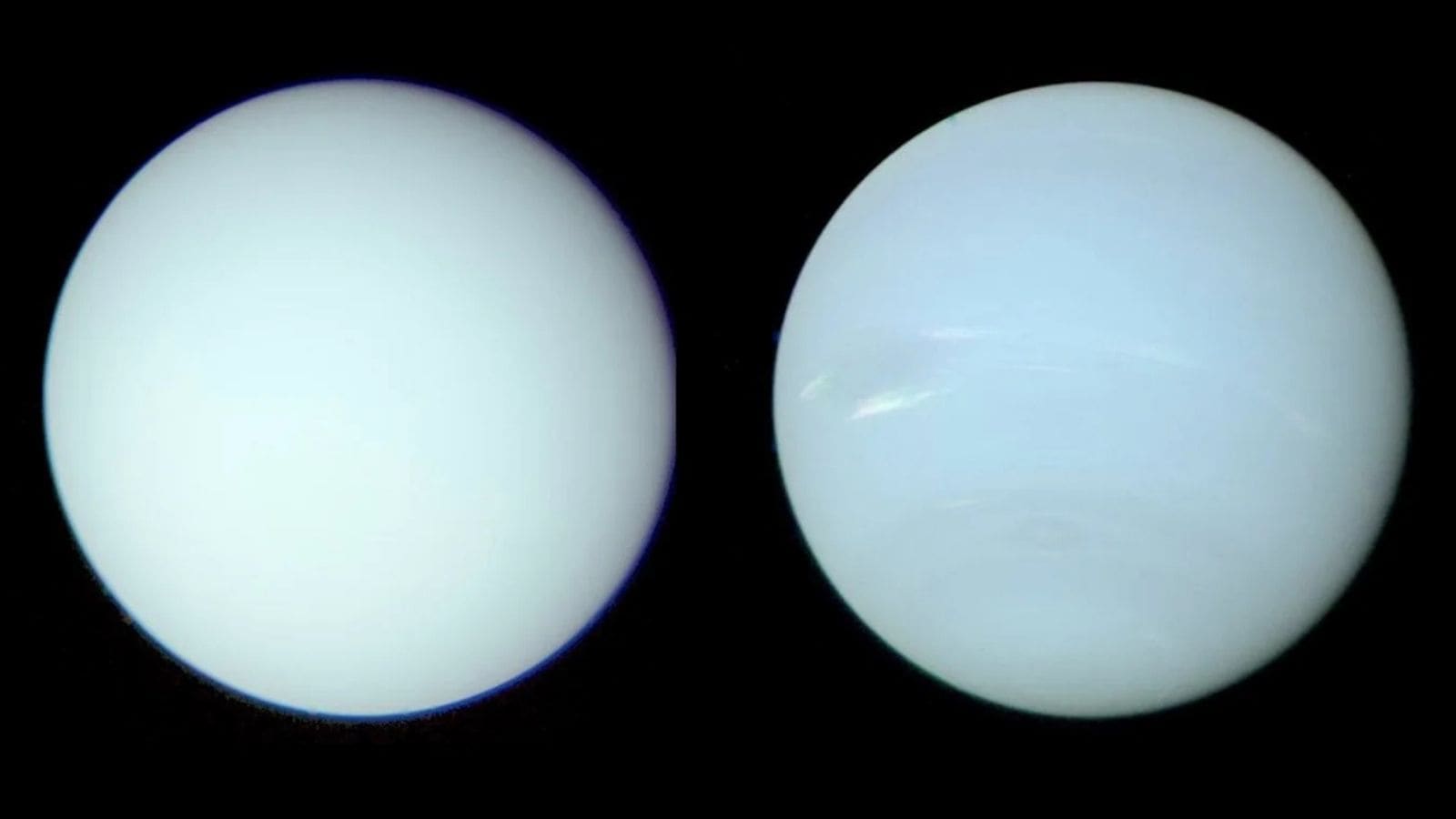
Post Content Uranus (left) and Neptune (right) are different shades of blue despite the many similarities they share in terms of mass, size and composition. (Image: NASA)
For decades, scientists have classified Uranus and Neptune as “ice giants” – massive outer planets believed to contain large amounts of icy material beneath their atmospheres. But new research is challenging that long-held understanding, suggesting the two planets may contain far more rock-rich material in their interiors than previously thought.
Researchers say the findings could reshape how scientists understand the composition of the two distant planets. “We found out that both Uranus and Neptune have their outer shells made mostly of rocks (and hydrogen and helium gas). This goes against the common belief that they are ice-giant planets,” author Yamila Miguel of the Netherlands Institute for Space Research told Space.com.
The new modelling study suggests Uranus and Neptune may contain more rock-rich material internally than scientists previously believed, challenging the traditional idea that the planets are dominated by ice. However, researchers have not concluded that the planets’ atmospheres are rocky, nor have Uranus and Neptune been officially reclassified.
The team used computer models to study the internal composition of Neptune and Uranus. Their hypothesis was partly inspired by observations of objects in the Kuiper Belt, including comets and Pluto, which are believed to contain significant amounts of rocky material. The researchers explored whether Uranus and Neptune may have formed from similar building blocks. “We thought, if those objects are made mostly of rocks, maybe Uranus and Neptune are as well?” Yamila Miguel said.
Also read | Physicists find possible cracks in a century-old model of the universe
To test the hypothesis, the researchers modelled the internal structures and compositions of Uranus and Neptune under extreme pressure and temperature conditions. The simulations examined how materials behave deep inside the planets, where intense pressure can compress particles and alter their physical state. According to the study, silicate materials may condense under these conditions, suggesting that rock-forming material could play a larger role in the planets’ interiors than previously thought.
“While they might have quite some ice in their interiors,” Miguel said, “they are definitely not completely icy as we used to believe.”
“We should indeed change their classification so as not to be misleading,” he suggests. “Rather than ‘icy’ or ‘rocky,’ we should simply call them minor giants or something like that.”
Story continues below this ad
This new finding could potentially change the classification of the two planets.
Also read | Can SpaceX and Blue Origin get their moon landers ready for NASA’s 2028 Artemis mission?
While the study does not officially reclassify Uranus and Neptune, it highlights how much scientists still have to learn about the outer planets of the Solar System. The findings could help researchers better understand how giant planets form, evolve, and differ from one another. The study also offers fresh insight into the complex internal structures and compositions of distant planetary worlds.
(This article is curated by Salonee Kulkarni, who is an intern with The Indian Express.)
