

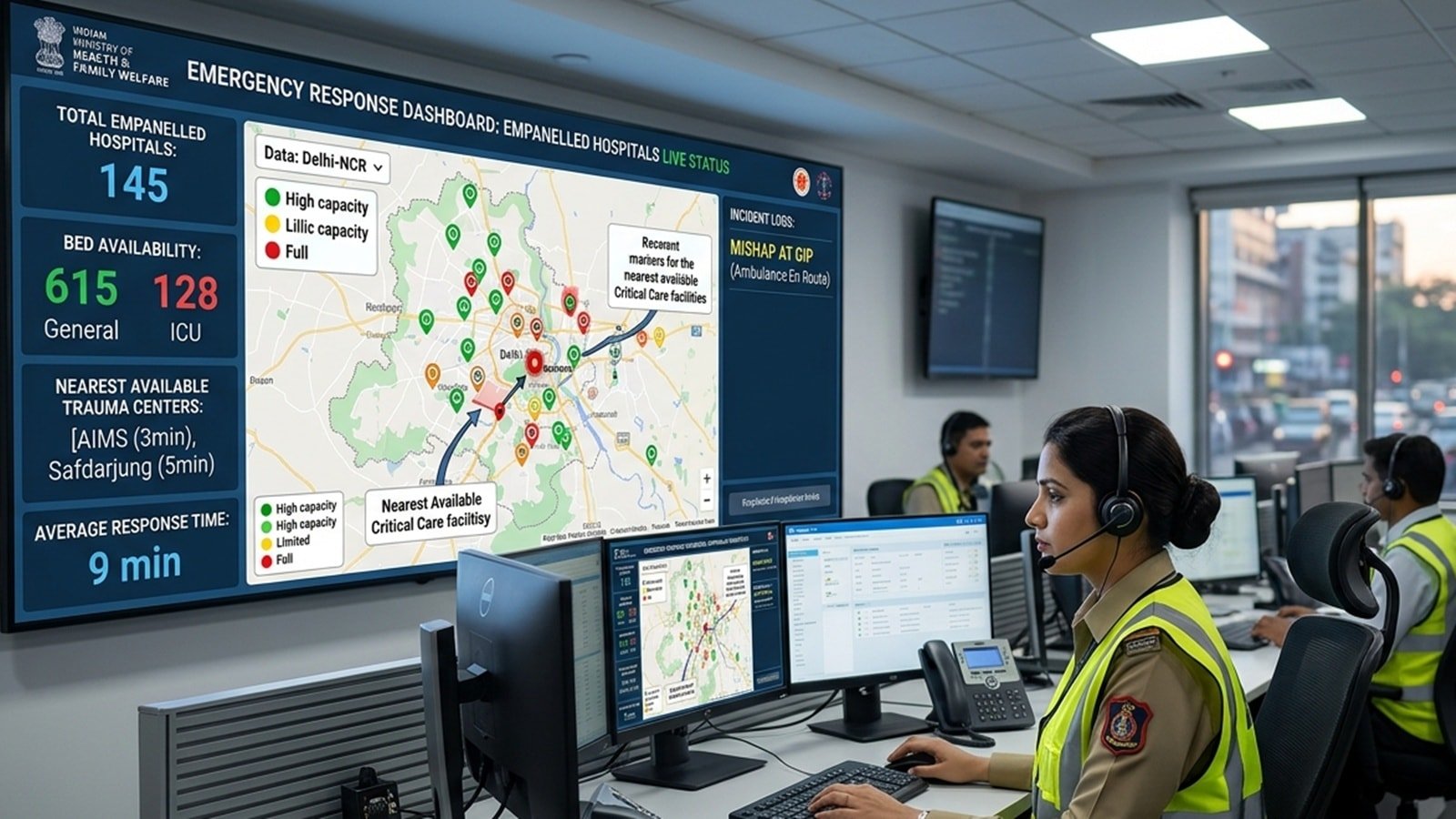
The committee has recommended that the dashboard be integrated with the existing 108 ambulance network. (Generated by AI)
A key question that first responders in road accident cases often face is this: Where exactly should they rush the victims to so that they can be provided with medical help in a time-bound manner?
To resolve this dilemma, a Parliamentary Committee has recommended that the government create a live public dashboard showing the location of hospitals empanelled under the PM-RAHAT scheme to enable Good Samaritans (or Rah-Veer) to take the injured persons to the relevant facility during the critical “golden hour”.
The committee has also recommended that the dashboard be integrated with the existing 108 ambulance network.
On February 13, the Ministry of Road Transport and Highways (MoRTH) launched the Prime Minister-Road Accident Victims’ Hospitalisation and Assured Treatment (PM-RAHAT) Scheme against the backdrop of rising road mishaps in India.
The standing committee on Transport, Tourism and Culture, though, raised concern over the achievement target of the scheme as “unquantified”.
The committee has recommended that the PM-RAHAT scheme be assigned quantified outreach targets within the Outcome Budget framework, including targets for the number of victims treated and hospitals empanelled, so that its efficacy can be objectively assessed, according to its report on the Demands for Grants (2026–27) of the MoRTH presented in the Rajya Sabha on Wednesday.
The Committee highlighted that the country records over 4.7 lakh road accidents and around 1.7 lakh fatalities annually, adding there is a need for timely medical intervention to save lives.
Story continues below this ad
Under the PM-RAHAT scheme, any road accident victim is entitled to get a treatment cover up to Rs. 1.5 lakh for a maximum of seven days. As per rules, the hospitals cannot deny treatment to the victims. The scheme also takes precedence over any other central or state level scheme.
According to the Ministry, the reimbursement to hospitals will be done through Motor Vehicle Accident Fund (MVAF), which is funded through contributions from general insurance companies for cases where the offending motor vehicle is insured, and through budgetary support for uninsured and hit-and-run cases.
Except West Bengal, all other states have been onboarded under the scheme.The Ministry informed the committee that the integration with the National Health Authority’s Transaction Management System has been completed in 33 states, with Tamil Nadu and Karnataka pending. Integration with the 112 emergency response system has been achieved in 31 states, while Maharashtra, Telangana, Rajasthan, and Uttar Pradesh are yet to be covered.Besides, 724 out of 756 district accounts have been opened for uninsured case payments, and grievance redressal officers have been appointed in 711 districts, the Ministry said.
PM-RAHAT is being implemented through the amalgamation of two existing platforms – eDAR (Electronic Detailed Accident Report) used by police officials for reporting of accidents and TMS 2.0 (Transaction Management System) of National Health Authority (NHA) used by hospitals for treatment, claim submissions and processing of payments.
Story continues below this ad
It has been observed that despite the schemes, passersby struggle to take road accident victims to appropriate hospitals due to lack of readily available information. A live dashboard showing the location of empanelled hospitals could go a long way in ensuring timely help to victims during the critical “golden hour” – the first 60 minutes after an injury.
© The Indian Express Pvt Ltd
