

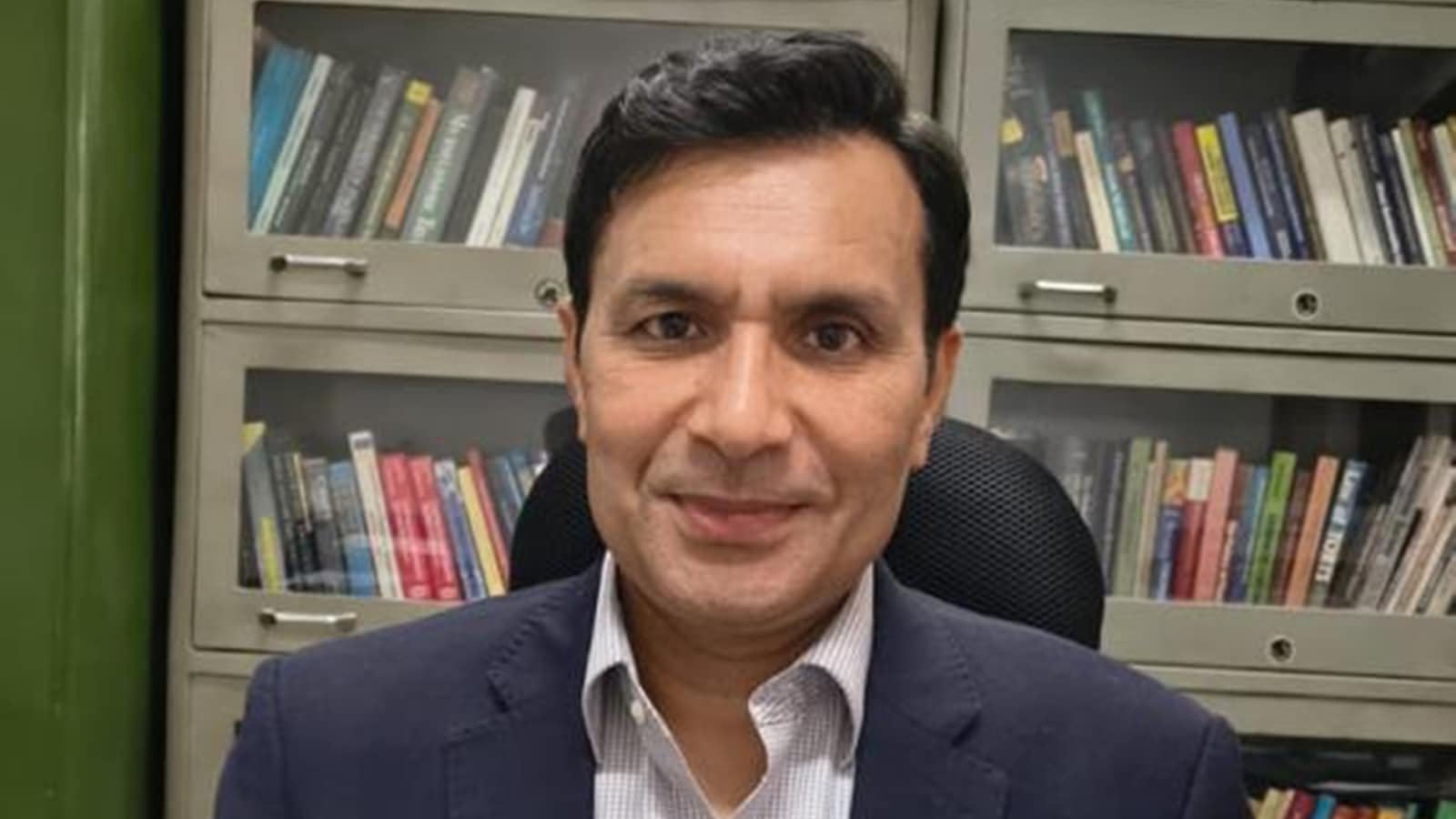
India does not face a crisis on the external front and there is no need to take measures such as the Foreign Currency Non-Resident (Bank) Deposit scheme of 2013 to mobilise money from abroad, according to Ram Singh, an external member on the Reserve Bank of India’s (RBI) Monetary Policy Committee.
According to Singh, the current situation is very different from 2013, with US interest rates much higher now, making it costly to raise deposits from abroad. “All considered, I don’t share the sense of alarm on rupee and forex fronts,” Singh, who is also Director of Delhi School of Economics, told The Indian Express in an interview. Edited excerpts:
The war is the latest in a series of shocks we have faced this decade. Are these repeated shocks impacting India’s potential growth?
They are, but they also help us improve. If we respond to the current situation by making the transition towards renewable energy consumption, by reducing our asymmetric dependence on the rest of the world for energy and other key inputs such as critical minerals and metals, build on the use of digital infrastructure to improve penetration of institutional credit, and prepare ourselves to adopt AI applications, we can expect significant productivity increases and a commensurate increase in our growth potential.
The high-growth phase of 2002-2012 saw high retail inflation of 5-11% and overleveraged corporate balance sheets, leading to the twin balance-sheet problem. This, in turn, induced the bad loan crisis. Today, we have slightly lower growth rates, but very low inflation and very healthy corporate balance sheets. This shows our potential growth rate is at least 8%, as 7%-plus is being achieved without heating the economy. And we know why that might be the case: infrastructure upgrades have brought down logistics costs, and the use of IT in governance and the private sector, for example, have led to improved productivity and growth potential. This shock can make us even stronger if we respond well to this by fixing some of the structural issues.
What do you make of the speculation about the need to raise capital from abroad?
The situation today is vastly different from 2013 when the RBI had introduced the special swap window for FCNR(B) deposits. In 2013, US interest rates were near 0% whereas today US yields are significantly higher at 4.4%, making it costly for us to raise capital from abroad. As such, in my view, there is no need for such measures.
Story continues below this ad
Our forex reserves today are around three times compared to 2013. We can look forward to reaping the benefits of FTAs that have been signed. There are indications that service sector exports will continue to do well. The conditions for foreign investment in corporate bonds and foreign exchange management regulations have been rationalised; we will see their impact on foreign portfolio inflows in the coming quarters. So, I do not see the need for a scheme like the FCNR(B) one of 2013.
There could have been a crisis if we insisted the rupee not cross 85 or 90-per-dollar. But yielding on that front in itself is shock absorber. The one weak point is our vulnerability to increase in crude oil prices. We saw this week on May 6 that a fall in crude oil prices led to rupee strengthening significantly by 60-70 paise. This suggests that post West-Asia conflict, we can expect the rupee to strengthen. All considered, I don’t share the sense of alarm on rupee and forex fronts.
There are some predictions that the repo rate could be increased in 2026.
As of now, it (rate hike talks) is over the top. Whether you look at the latest price data or the projected inflation trajectory, rate hike concerns are not justified, in my view. CPI inflation is forecast at 4.6% for FY27, comfortably within the tolerance band.
Story continues below this ad
These concerns are also misplaced because of two sets of developments on the external front.
One: the West Asia conflict prolonging is not in the interest of any country, including the nations involved in the conflict. In the US, for instance, retail gasoline prices and airfares have gone up, 10-year bond yields have spiked to 4.4% from 3.97% on February 27.
These factors, along with political economy considerations, should encourage the countries involved to work out a deal sooner rather than later.
Two: even today, when our resilience is being stress-tested, forex reserves of $691 billion are not far from the all-time high of $728 billion. Moreover, pressure on the rupee will not be there absent this crisis because we have worked out FTAs with 37 countries whose benefits will accrue in the coming months through trade and investment channels.
Story continues below this ad
Absent crude oil and its short-term consequences, we are in a good position.
How would you rate the economy if GDP growth in FY27 is, say 6.5%, and inflation averages under 5%?
Given the supply-side shock, that’s very much acceptable. We will still be the fastest growing major economy with limited increase in prices.
The RBI’s inflation forecast rises from 4% in April-June to 4.7% in the final quarter of 2026-27. Is it underestimating the upside risks because of the assumption of a normal monsoon, the possibility of the El Nino conditions, and the continuation of the war?
Story continues below this ad
The MPC forecast has factored in 8% deficit in monsoon. We have also assumed that the average crude price for FY27 would be $85 per barrel, but it is to be seen if that holds or not.
Regarding El Nino: the last two years have seen normal monsoons. As a result, reservoir levels are higher than the long-term average, and our food stock buffer is also comfortable. The El Nino disturbances are forecasted to affect the latter half of the southwest monsoon season. Even if that happens, the consequences might not be that alarming if there is fair geographical and intertemporal spread of rain.
Where the real uncertainty lies is in the duration of the conflict — and therefore the average crude oil price — and the degree of pass-through. The Centre’s decision to keep retail oil and prices in check has protected the masses from the full impact of the crisis. Overall, there is an upside risk to prices, but I feel confident that inflation would be within the tolerance band and the price pendulum will not swing wildly.
How does the MPC plan to tackle second-round effects of the higher energy prices due to the war? Would you wait until they materialise or act when initial signs occur, such as higher prices being passed on via retail channels?
Story continues below this ad
We are expected to be forward-looking and that reflects in our inflation forecast, whose upward trajectory is not borne out by the data that is coming out; in March, for instance, price rise was modest with CPI inflation only 3.4%. So, we are not looking only at the latest data but have also factored in both first-round and second-round effects. Our assumption, though, is of limited pass-through of crude oil prices.
Some pass-through has happened, through two channels: price of gas supplied to the industrial sector and the exchange rate channel. As a result, prices have started to pick up in some product lines. But as long as the government staggers retail diesel, petrol, and LPG price hikes, I expect the second-round effect to be moderate.
Even if the government does not allow any increase in retail energy and urea prices, some pass-through is still inevitable. In this case, the government will have to accept a higher fiscal deficit to bump up the energy and urea subsidies. In my view, it is important to increase retail prices to give the right kind of signals to people and businesses to switch over to alternate energy sources. That will also reduce our import bill. The second-round effects will be limited if the increases in retail energy prices are moderate and staggered.
A forward-looking perspective requires us to have at least a one-year horizon and not overreact to what is happening in the immediate. Our 5.2% inflation forecast for the third quarter includes some pass-through and its second-round effects. By October-December quarter, I expect the second-round effects to play out and inflation to be on the downward trajectory.
