

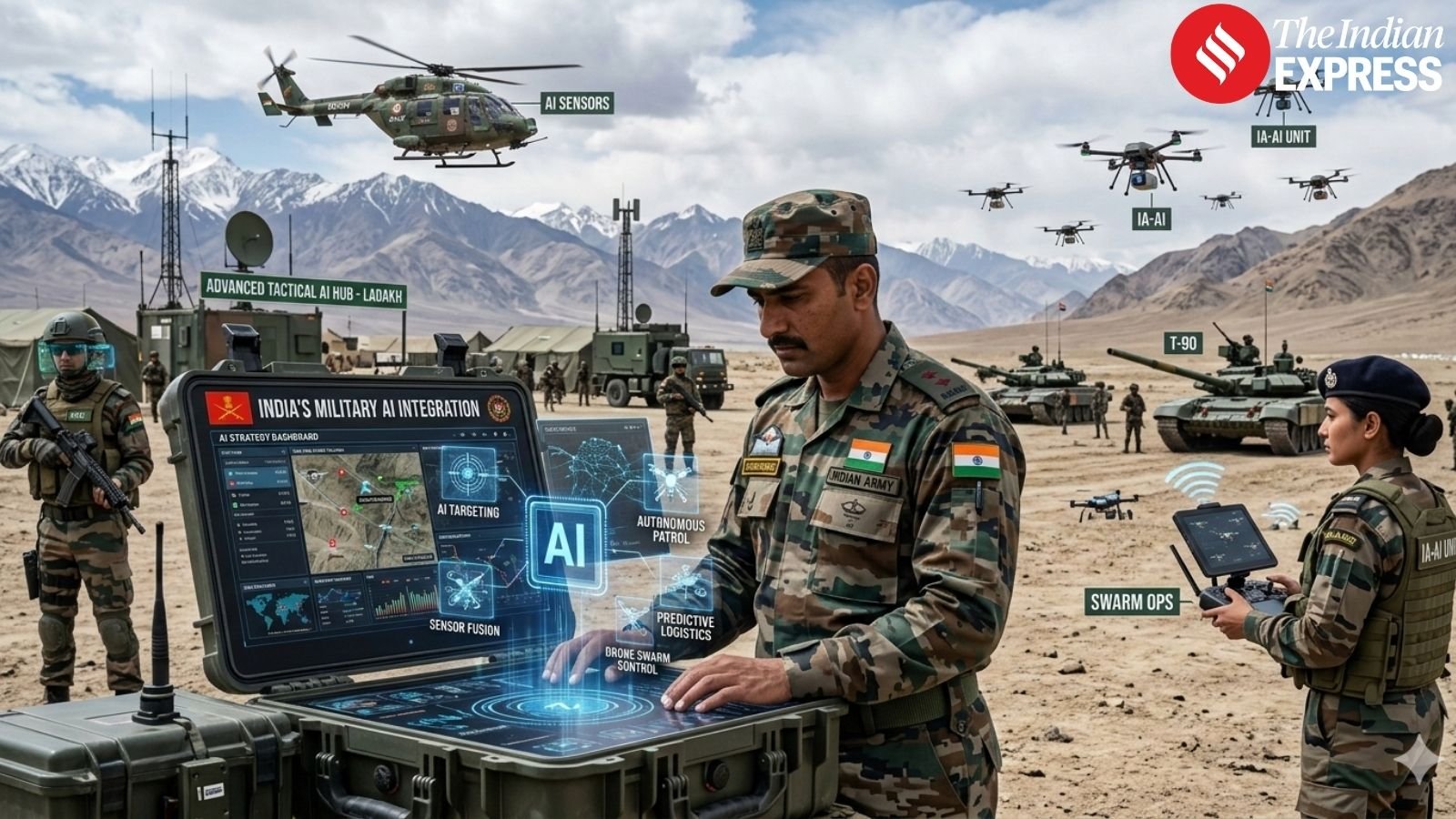
As the Indian defence establishment evaluates the ongoing conflict in West Asia, a compelling need is being felt for the military to have access to domestically-made artificial intelligence (AI) systems, amid a concerted push to decouple from foreign-made technology in strategic sectors, The Indian Express has learnt.
The defence ministry is currently in conversations with Indian companies like SarvamAI and BharatGen — that have built domestic AI models — on how the technology can be integrated with India’s existing defence capabilities, three senior government officials said.
“The idea is to have an Indian version of Palantir as soon as possible,” an official said. To invest in a foundational model of our own has a growing strategic imperative, even if we’re behind the curve, another official involved in the broader deliberations said.
The conflicts in Iran and Ukraine, where the defence forces are said to have used AI effectively to take operational decisions, have shown New Delhi that the technology can be a game changer, not just as a defensive resource, but as an offensive option as well. In the US, systems developed by the likes of Palantir were used in strikes carried out on Iran. The technology has also been used to carry out cyber attacks on digital infrastructure.
Read | From training to battlefield: How AI is redefining India’s military capabilities
China, for instance, is rapidly integrating artificial intelligence into military operations as part of the push by the People’s Liberation Army (PLA) towards what’s being described as “intelligentised warfare”. Chinese military planners are using AI for battlefield decision-making, autonomous drone swarms, surveillance, target recognition and command systems that can process combat data in seconds. Recent studies of PLA procurement documents show strong focus on AI-enabled command-and-control and reconnaissance systems, aimed at speeding up operations and countering US military advantages. China has also showcased AI-powered robotic “wolf pack” combat systems and autonomous drone platforms.
The key question though is whether India should rely on existing AI solutions for warfare, with the government and the country’s military establishment believing that domestic options might be the better alternative for strategic sectors such as defence.
“Using American AI models to build products as wrappers on top of them might work in other business fields, but when it comes to strategic sectors, it is clearly being felt that there is a need to have our own technology, at least invest in them and build them, so that we are not reliant on something that we source from outside,” a second official said.
Story continues below this ad
Even if extensively large models like those built in the US may not have been created in India so far, the military sees merit in deploying domestically-made small models for use on the ground. “Such AI can still help guide our autonomous systems for surveillance, reconnaissance and target mapping, and aid in intelligence fusion,” a senior government official said.
Intelligence fusion in the military refers to the process of aggregating, analysing and integrating data from multiple sources — such as signals, imagery and human intelligence — to create a unified, actionable and real-time picture of threats. This concept is evolving into Intelligence Fusion Systems, which utilise AI and machine learning to rapidly process data, reducing the time from data collection to decision-making.
“From our conversations with local players, what we have understood so far is that the difference in models that have been built domestically by companies like Sarvam and BharatGen is not that much when compared with Deepseek, or at least the gap can be bridged, even though there might be a lag. But we need our own model, no question about that,” another official said.
One of the reasons behind that is also the money involved in building AI models. General purpose large language models such as those built by companies like OpenAI and Anthropic take substantial investments, with computing alone costing close to $200 million, and data training and annotation costs can take that figure up to $500 million-$600 million. Smaller models which are tuned for specific purposes may be cheaper to build comparatively. Indian firms may also struggle in matching compute access that some of their Western counterparts have, although the government has tried to address that handicap by providing them GPUs at discounted usage rates under the IndiaAI Mission.
Story continues below this ad
Queries sent to the defence ministry and SarvamAI did not elicit a response until publication.
What has also irked New Delhi are comments made by senior US administration officials earlier this year, where they insisted that the US expects that its allies, including India, should build their AI solutions on top of the so-called America AI stack.
To be sure, the Indian armed forces did use AI cloud-based integrated air command and control systems to detect and position any hostile objects in the sky during Operation Sindoor last year, as reported by The Indian Express. Also, during the India AI Impact Summit earlier this year, Lt General Dinesh Singh Rana, chief of the Strategic Forces Command, revealed that the Army had deployed AI predictive tools to anticipate and repulse a Chinese attempt along the Line of Actual Control (LAC) in Yangtse, Arunachal Pradesh.
There is, however, a refrain around India’s hardware capabilities in these discussions, officials said. “Even if our start-ups are able to build AI-led systems for military use cases, the underlying hardware that is powering those, including the graphics processing units crucial for computing power, are currently all made by foreign companies. We don’t have that level of technology at our disposal yet, but it is something that has to be ensured in the coming years,” a senior government official said.
