

Post Content
Motorola India Managing Director T M Narasimhan said that the impact of rising memory chip prices on smartphone demand in India, the world’s second-largest phone market by volume, will vary by segment, with some price points likely to see steady demand while others could face a sharp slowdown as consumers postpone purchases.
“It is likely to be mixed, depending on the price points. At certain price points, consumers may still be willing to absorb the price increase. In those segments, demand may not soften much. However, at other price points, there could be a sharp decline in demand, as consumers may choose to delay their purchases,” Narasimhan told indianexpress.com in an interview at the Motorola office in Gurgaon.
Narasimhan said the company has already adjusted smartphone prices in the country, as memory prices have surged to unprecedented levels in recent years. However, he warned that smartphone prices will continue to rise, as brands like Motorola have no option but to increase hardware prices to offset the rising cost of memory chips.
“The biggest impact will obviously be in the sub-Rs 10,000 segment, followed by the Rs 10,000 to Rs 15,000 range and then the Rs 15,000 to Rs 20,000 segment. We are already seeing demand shrink in the below-Rs 10,000 and Rs 10,000 to Rs 15,000 categories. The Rs 20,000 to Rs 25,000 segment is still holding up for now, but I expect stress to emerge over the next three to four months. As a Rs 15,000 to Rs 20,000 phone moves to Rs 25,000, and a Rs 25,000 phone shifts to Rs 35,000, we will begin to see the next demand cycle play out,” he said.
‘Prices are going to go up’
Narasimhan said smartphone prices have already increased sharply due to surging memory costs, with devices that sold for around Rs 7,000 last year now priced at Rs 12,000 to Rs 13,000. He warned that further price hikes expected over the coming months could push these phones into the Rs 16,000-18,000 range, putting pressure on consumers’ budgets, especially in the sub-Rs 20,000 segment.
“Many consumers may delay upgrading to a new smartphone,” he said.
“Every player is going through this now. It is what I would call a ‘black swan’ event for the mobile industry, one that is spiralling things out of control.”
Story continues below this ad
Motorola expects smartphone prices in India to continue rising over the next six to eight months amid a global memory chip crunch. (Image: The Indian Express/ Anuj Bhatia)
He said that being part of Lenovo puts Motorola in a strong position to secure memory supplies. However, he said pricing will ultimately depend on broader industry trends.
“Prices are going to go up, and that’s a reality. Have they already gone up from October to now? Yes, they have. Do I see them continuing to rise over the next six to eight months, for which I have visibility?
Definitely, yes. They will go up further.’
The primary driver behind this rally is the expansion of artificial intelligence infrastructure. Major technology companies are buying up advanced memory supplies (also used in laptops and smartphones) for AI servers and data centres, putting strain on the semiconductor supply chain. As a result, laptop and smartphone prices are coming under pressure. Not only are newly announced 2026 models seeing massive price hikes, but 2025 models are seeing price increases as well.
Also read | ‘We have an extended supply chain from our parent organisation…delayed price hikes longer than competitors’: Motorola exec on global RAM shortage
Last year, leading phone companies employed different strategies to avoid raising prices due to tariffs, including shipping more inventory in advance and shifting manufacturing to countries with lower tariffs. However, these strategies are less likely to work in 2026, as rising costs are now affecting the basic cost of production, and the impact is global rather than limited to specific markets.
Story continues below this ad
Insiders say the ability of major phone makers to maintain their margins will be tested in the second half of the year. Memory can account for around 10 per cent to 15 per cent of the total bill of materials for a high-end smartphone, according to the research firm IDC.
In India, Motorola increased its market share to 7.5 per cent in Q1 2026, according to the International Data Corporation (IDC), becoming one of the top five smartphone players. Motorola is among the few smartphone makers that have recorded 14 per cent year-over-year growth, even as the overall Indian smartphone market declined by 4.1 per cent.
Targeting the premium segment
For brands like Motorola, the bigger challenge now is to grow market share in the premium segment, where higher average selling prices (ASPs) can generate greater revenue and profits even with lower unit sales. However, the premium segment is growing at single-digit rates, according to Narasimhan.
Motorola India Managing Director T M Narasimhan says rising memory chip prices are pushing smartphone costs higher across segments. (Image: Motorola)
“For us to grow in the premium space, where we are currently up to Rs 35,000, we have a double-digit share. Greater than Rs 35,000 is where we don’t have much presence right now, so it is a question of gaining share in that segment,” he said.
Story continues below this ad
Motorola is trying to grow its market share in the high-end smartphone segment, which is predominantly dominated by Apple and Samsung.
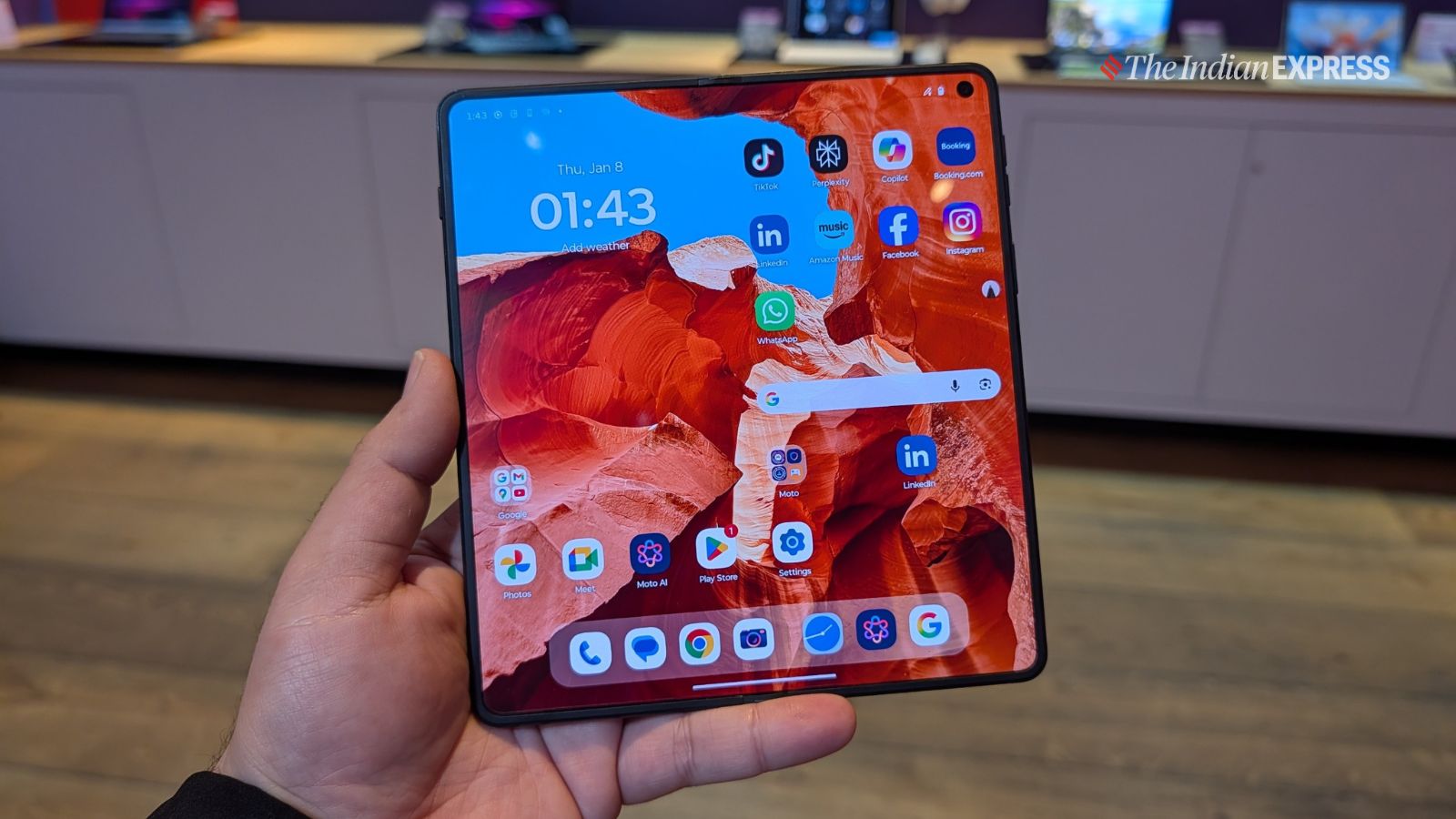
Earlier this year, the company debuted the Signature series to enter the mainstream flagship space, and at the same time, it continues to double down on foldables with its Razr brand, which is being expanded with the new Razr Fold, its first book-style foldable smartphone.
Motorola is not new to foldable smartphones. In fact, the company was one of the first brands to launch a flip-style foldable phone in 2019 and revived the Razr brand. The company has been active in the flip-style foldable space, where it holds around 50 per cent of the US foldable market and has grown its global share from about 6 per cent to nearly 14 per cent. However, as Narasimhan pointed out, the flip-style foldable form factor has not performed well in India, as consumers here have a greater affinity for larger screens.
The Razr Fold could be appreciated by Indian consumers and open the door for Motorola in the ultra-high-end segment. With the debut of the Fold, it should serve as Motorola’s answer to take on Samsung and Apple, with the latter rumoured to foray into the foldable smartphone market later this year.
Story continues below this ad
Also Read | Motorola Moto Watch review: This ‘accessible’ smartwatch offers long battery life and better fitness metrics
The Razr Fold, priced from Rs 149,999 in India, features an 8.1-inch inner display with 2K resolution and a 6.6-inch outer display. It packs a triple 50-megapixel rear camera system, a 32-megapixel selfie camera on the cover screen, and a 20-megapixel front camera on the inner display. It also has a 6,000 mAh battery and is powered by a Snapdragon 8 Gen 5 processor. Motorola is focusing on cameras and long battery life as key differentiators.
Looking at alternatives
But as smartphones become more expensive due to the ongoing memory crisis and more people hold onto their phones for longer, the question is how brands like Motorola can keep growing while demand for new phones declines. An alternative would be to enter the used smartphone market, but Narasimhan said the company does not want to pursue it.
“It’s a very complex business model,” Narasimhan said while outlining the challenges in the used smartphone market.
Narasimhan said the idea looks “theoretically brilliant,” but raised concerns about its practical execution, particularly about aggregating used phones and sourcing spare parts once production lines for older models have been shut down. He noted that with the average smartphone used for two to three years, securing components for older devices remains a key challenge.
Story continues below this ad
“What is the cost? It is a pure business case. What is the cost of procuring old phones? How many of them will be in a refurbishable condition? After identifying those that are refurbishable, how many will actually have spare parts available? If you build the funnel and the business case makes sense, then someone will enter it. Otherwise, it doesn’t make sense to go into it, which is why brands avoid it,” he said.
In the coming months, the memory crisis is expected to intensify, and all major phone brands, including those operating in the high-end and premium segments, will be affected, including Apple, which in recent years has increased its market share in India by selling older iPhone models, a strategy that has worked so far. But a company as big as Apple is also not immune to the memory crisis. In India, the iPhone 15 and 16 have already become more expensive after the company withdrew retail incentives, leading to price increases of about Rs 5,000.
Experts say the memory chip crisis could reduce phone companies’ pricing flexibility, especially if they aim to maintain strong mass-market demand for their products. This may hit India hard, where the rupee is weakening against the US dollar, reflecting the country’s struggle to attract foreign capital amid rising energy import costs.
Narasimhan said he expects no major discounts during the festive season due to rising prices. “There might be discounts in September and October, but as I see it, October prices are going to be higher than current levels. That is the way prices are moving. So even discounted festive prices are likely to be higher than today’s May prices. That is how the industry is moving today,” he said.
