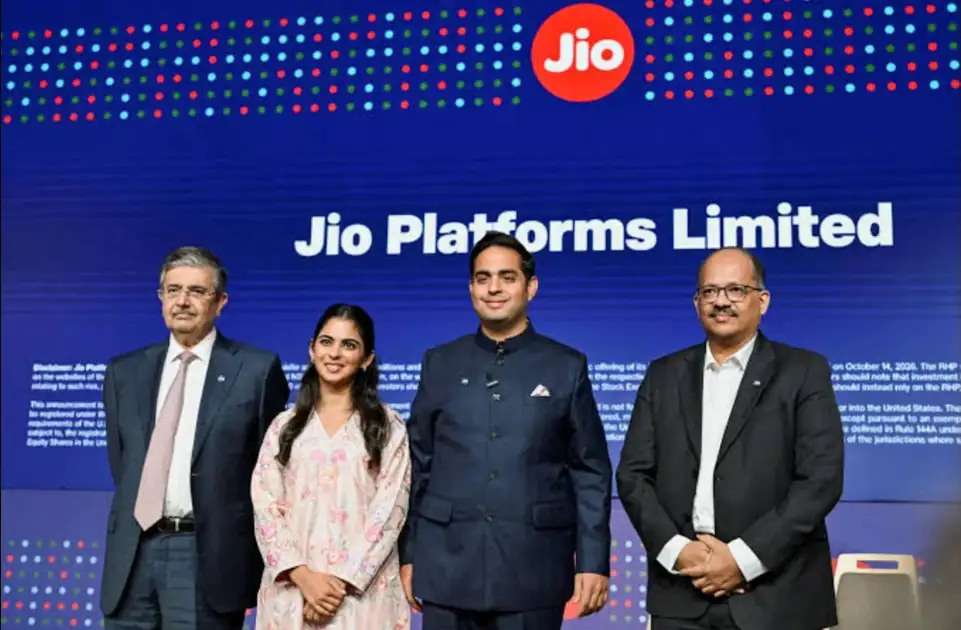

Shares of Jio Platforms jumped another 5% on Thursday, extending gains after a strong market debut at a 21.36% premium to the IPO price. The stock had closed its listing-day session at Rs 1,417.
The telecom major's shares jumped to Rs 1,482.70 apiece on NSE. The stock is currently more than 32.5% up from the IPO price.
Jio Platforms Ltd. became India’s second-largest listed company by market capitalisation on its debut, after its shares listed at Rs 1,358. The listing valued the company at around Rs 12.5 lakh crore, putting it ahead of Bharti Airtel, with a market capitalisation of roughly Rs 12.1 lakh crore, and behind only its parent, Reliance Industries, valued at about Rs 15.95 lakh crore.
Investor demand for the IPO was strong, with the issue fully subscribed within 100 minutes of opening. The Rs 5,500 crore portion reserved for qualified institutional buyers (QIBs) was subscribed within the first 10 minutes. By the close of the third day, the IPO had received subscriptions of 22.2 times the shares on offer, while the QIB portion was subscribed 70.55 times.
Also read: No. 2 on Day 1: How Jio Platforms broke India’s market cap hierarchy in debut trade
Buy, sell or hold the stock?
Nomura: Disruptor has emerged as the leader
Nomura initiated coverage on Jio Platforms with a Buy rating and a target price of Rs 1,340. According to TRAI data, Jio held a 41.7% share of India's wireless subscribers, excluding M2M, in August 2026. Its extensive 5G coverage, data usage per subscriber that is 27% higher than Airtel's and the lowest monthly churn rate among peers at 1.6% position it well to narrow the average revenue per user (ARPU) gap with Airtel, the brokerage said. An industry-wide tariff hike of 15% in November-December 2026 could provide an immediate boost to ARPU.
With most of its 5G investment cycle behind it, Jio is expected to reduce capital expenditure (capex), with capex declining to around 23% of revenue in FY26 from 35% in FY25. This is expected to release significant cash flow and drive a sharp improvement in free cash flow (FCF).
Nomura also highlighted an improvement in Jio's balance sheet. Net debt-to-equity, including deferred payment obligations, declined to 0.37 times in FY26 from 0.56 times in FY24. The brokerage expects Jio to become net debt-free by FY29.
Read more: Jio Platforms shares to be available under MTF from Day 1. What should investors know?
The brokerage believes Jio could command a premium to Bharti Airtel's India business in the near term, supported by its market leadership, greater influence over industry tariffs and a free float of less than 3%. However, its earnings and valuation estimates remain highly sensitive to growth in wireless ARPU.
Elara Capital: Affordability is Jio's digital springboard
Elara Capital initiated coverage on Jio Platforms with a Buy rating and a target price of Rs 1,367 per share.
The brokerage expects mobility to remain the primary driver of revenue and profitability. Subscriber additions are projected to grow at a CAGR of 3% during FY26-29E, supported by affordable plans, an extensive network and low churn.
Elara also expects a tariff hike of 12-15% in H2FY27E. Combined with migration from 2G to 4G and 5G, prepaid-to-postpaid upgrades, premiumisation, higher data consumption and bundled digital services, this is expected to lift ARPU from Rs 214 in FY26 to Rs 257 in FY29E.
Read more: Jio Platforms shares list at 21% premium over IPO price. Should investors buy, sell or hold the stock?
Affordable data continues to underpin Jio Platforms' ecosystem for consumers and enterprises. The company uses its customer base and distribution platforms to integrate third-party services, lower customer acquisition costs and deepen customer engagement.
Elara sees India's underpenetrated digital services market as a structural growth opportunity for Jio across enterprise cloud, communications and consumer productivity solutions.
Disclaimer: This article has been written by Veer Sharma, who is not a SEBI-registered Research Analyst or an Investment Adviser. Veer Sharma and his/her ‘relative(s)’ (as defined under Section 2(77) of the Companies Act, 2013) do not hold any financial interest in the companies mentioned in this article as of the date of publication. The views/recommendations mentioned in this article, wherever applicable, are those of the respective SEBI-registered Research Analyst/brokerage and have been reproduced/reported with due attribution. They should not be construed as the views or recommendations of The Economic Times Digital or the journalist. Readers are advised to consider the original research report and make their investment decisions based on their own assessment. Brokerage disclaimers here.