

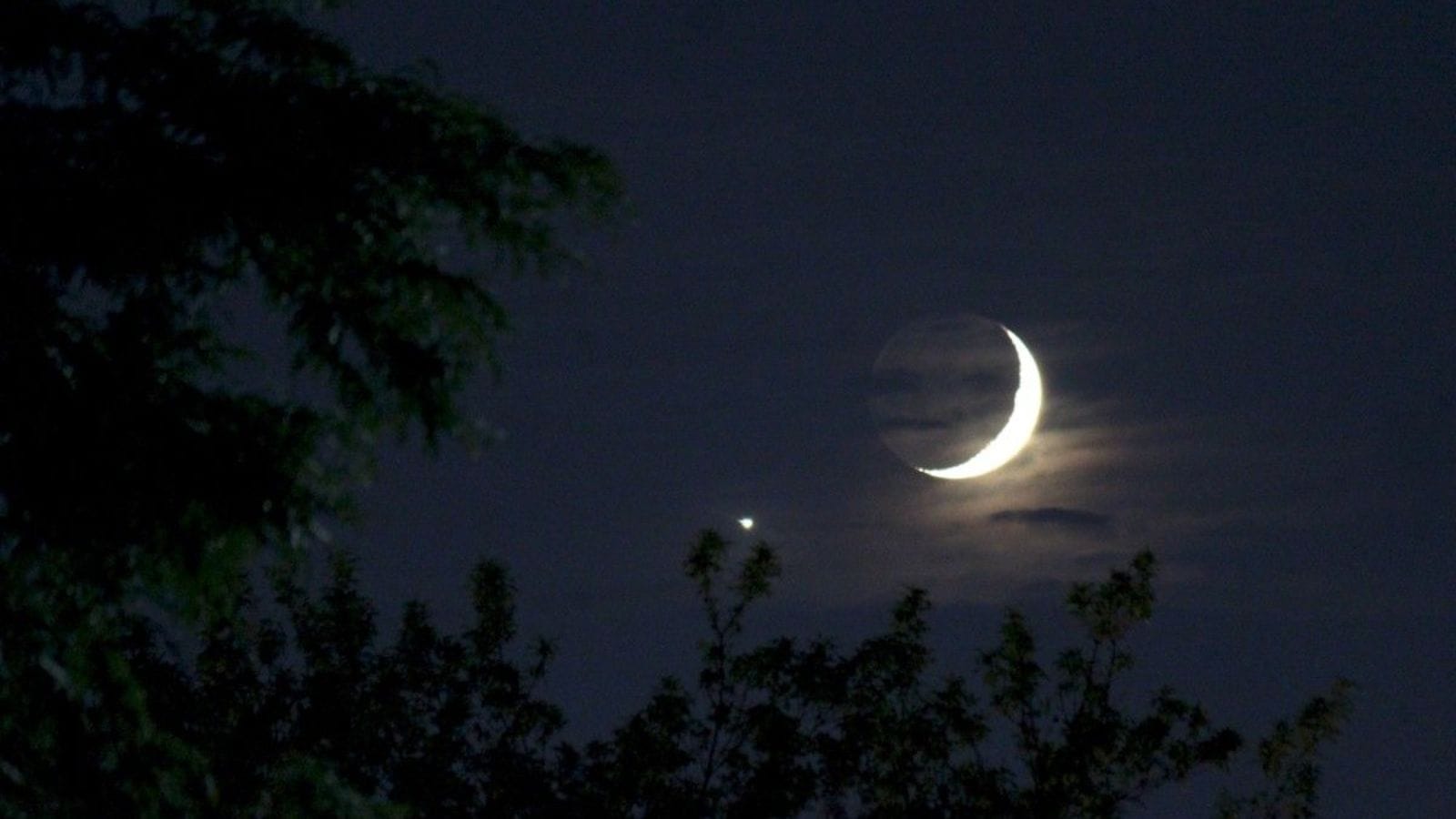
Post Content Star gazers and observers on Monday, May 18, can witness the brilliant Venus shining alongside the slender crescent moon. (Image credit: NASA/Bill Dunford)
Star gazers and observers on Monday, May 18, can witness the brilliant Venus shining alongside the slender crescent moon, 2.1 days past the new moon, illuminating at only 7 per cent.
Despite the distance between the two objects, they rarely fail to turn heads when they appear in proximity. To observe the distance and witness the magic unfold of a pairing in the dusk, clench your fist at arm’s length, measuring 10 degrees. On Monday evening, you will witness the moon sitting about three degrees to Venus’s right, or one-third of the fist-width gap.
Venus currently sets around 10:50 pm local daylight time. The second week of June marks the peak when the planet reaches its current evening, a point at which it remains above the horizon until 11 pm. It then descends below the ecliptic plane from the observer’s perspective.
Also read | A comet from another star system? Watch interstellar 3I/ATLAS live tonight
Many people believe that it’s Venus that appears brighter, due to its small size and sharp point of light; interestingly, it is the moon that appears brighter. Venus currently shines at 4.0 magnitude, appearing luminous. However, the thin crescent moon shines 17 times brighter! The reason behind people’s belief in Venus appearing more luminous than the moon is that the moon spreads its light to a larger area, making it appear dimmer.
The illusion is due to a perspective not taken into consideration. The moon and Venus are not in proximity to each other in space. The moon is 224,000 miles (360,000 km) from Earth, while Venus is 124 million miles away. However, Monday seems to be the day when this illusion is broken due to the alignment, which makes them appear closer to each other.
Also read | Can a star die twice? Scientists spot rare cosmic ‘double detonation’
Throughout May, Venus pulls away from the Sun; this angular separation is called elongation, which grows at 24 to 32 degrees. From the northern temperate latitudes, Venus is positioned at 25 degrees above the horizon, making it easier to spot. It is yet to reach its visibility as of 2026. It is positioned at 10 to 20 degrees east of the sun, thus maintaining its historical records of visibility.
Interestingly, the still-bright twilight sky actually works in your favor if you want to observe Venus through a telescope. It is the illuminated sky that reduces the glare of Venus despite Venus being in its gibbous phase, similar to the moon. Seven-eighths of its disk is illuminated, though it appears smaller to the observer.
Story continues below this ad
(This article is curated by Salonee Kulkarni, who is an intern with The Indian Express.)
